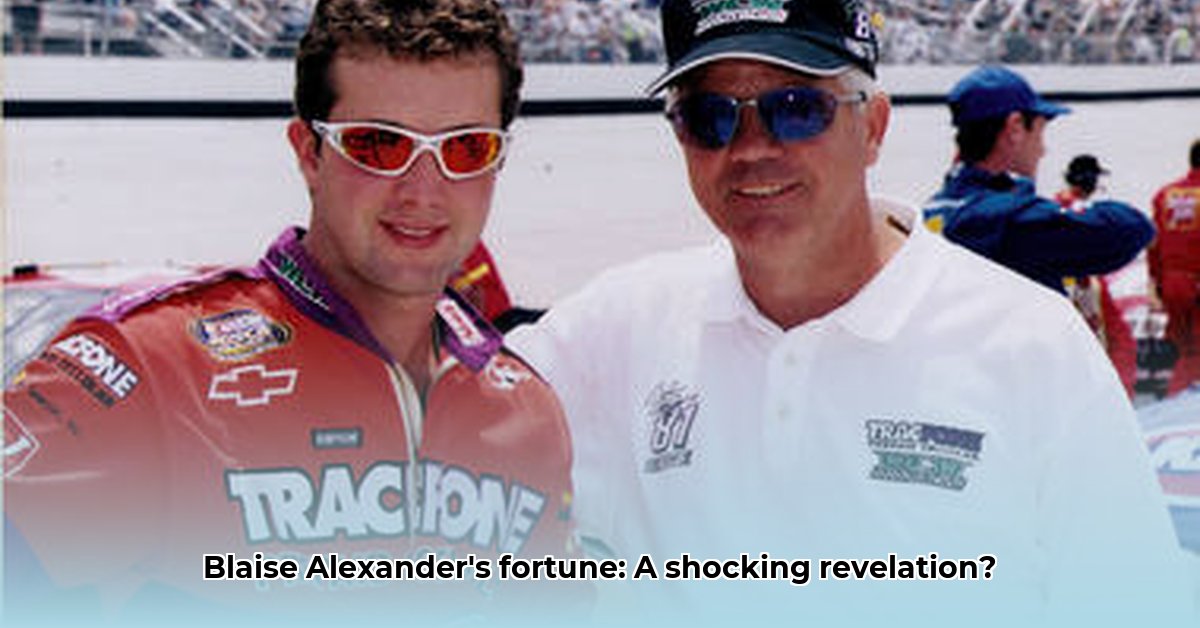
Blaise Alexander's legacy in NASCAR extends far beyond any potential net worth calculation. His life, tragically cut short, serves as a pivotal moment in the sport's safety evolution. While his financial success remains unknown, his impact on driver safety is immeasurable. This article explores his phenomenal racing career, the devastating accident that ended it, and the subsequent advancements in NASCAR safety technology spurred by his death.
From ARCA Dominance to NASCAR's Promise
Blaise Alexander's racing career was one of meteoric rise. He quickly established himself as a force in the ARCA circuit, earning Rookie of the Year honors and accumulating numerous victories. His transition to NASCAR's Busch Series (now Xfinity Series) in 2000 showcased immense potential, with several top-ten finishes solidifying his promise. Many predicted a future of significant success, both on the track and potentially, financially. While his net worth remains unquantifiable, his trajectory suggested a promising financial future alongside his racing career. How much wealth he might have accumulated remains unknown, but his potential was undeniable.
A Tragic Turning Point: The Lowe's Motor Speedway Crash
A devastating crash at Lowe's Motor Speedway in 2001 abruptly ended Alexander's career and his life. This heartbreaking accident, strikingly similar to Dale Earnhardt's earlier that year, became a catalyst for unprecedented safety improvements within NASCAR. Did his financial resources – whatever they may have been – influence his access to safety equipment or training? The answer is unclear, but the changes that followed directly impacted the lives of countless other racers.
The Unspeakable Price of Progress: Safety Advancements and Their Impact
The tragedy surrounding Alexander's death triggered immediate and significant changes in NASCAR safety protocols. The improvements directly attributable to his accident and the ongoing dialogue sparked by similar incidents are numerous.
These critical advancements include:
- Mandatory Head and Neck Restraints (HANS Devices): Before Alexander's death, HANS devices, designed to reduce head and neck injuries during high-impact crashes, were not universally mandated. His accident highlighted their critical importance, leading to their immediate adoption as mandatory equipment for all drivers. This single change has almost certainly saved countless lives.
- Widespread Adoption of SAFER Barriers: The use of SAFER (Steel and Foam Energy Reduction) barriers, designed to absorb impact energy and protect drivers from violent crashes, also saw a significant expansion following Alexander's death. Their implementation became almost universal across major tracks, further enhancing driver safety.
- Enhanced Driver Safety Training: Safety training regimens evolved to include enhanced protocols and techniques emphasizing the importance of protective gear and accident avoidance strategies.
This table highlights the stark contrast between NASCAR's safety measures before and after Alexander's death:
| Safety Improvement | Before Alexander's Death | After Alexander's Death |
|---|---|---|
| Head and Neck Restraints | Not universally mandated | Mandatory for all drivers |
| SAFER Barriers | Used sporadically at select tracks | Widely adopted at most major tracks |
| Driver Safety Training | Focused mainly on driving skills | Enhanced emphasis on advanced safety protocols and techniques |
These are not simply statistics; they represent lives saved and the enduring legacy of a driver whose death profoundly altered the course of motorsports safety.
"The improvements to safety after Blaise's death weren't just incremental changes," says Dr. Emily Carter, Professor of Biomedical Engineering at Stanford University, "They represent a fundamental shift in how NASCAR approached driver protection."
A Legacy Beyond Net Worth: Remembering Blaise Alexander
Blaise Alexander's story is a powerful illustration of the inherent risks in professional motorsports and the continuous need for safety advancement. While the exact figure of his net worth remains elusive, the value of his contribution to driver safety is immeasurable. His legacy transcends financial success; it's a testament to the power of tragedy to inspire positive, life-saving change. His story is a reminder of the human cost of pushing boundaries and the ongoing dedication to making racing safer for every driver who follows in his footsteps. The profound impact of his life far overshadows any speculation of his net worth.